How to Check Coolant Level in Porsche Cayenne?
If you own a Cayenne, keeping up with routine maintenance is essential to protect your investment, and checking the coolant level is one of the most straightforward tasks that also happens to get overlooked most often. It takes less than five minutes, requires no tools, and can prevent one of the most expensive types of engine damage, overheating. This covers exactly how to check your Cayenne's coolant level correctly, what to look for, and what to do if the level is consistently dropping. A Peoria Porsche mechanic can walk you through it in person if you'd rather not go it alone the first time.
Why Coolant Matters More Than Most Owners Realize
Coolant does more than prevent overheating. It also prevents freezing in cold temperatures, inhibits corrosion inside the cooling system, and lubricates the water pump. Without adequate coolant at the correct concentration, your Cayenne's engine operates under thermal stress that accelerates wear on gaskets, seals, and cylinder head components, damage that is expensive to repair and entirely preventable.
In Peoria's extreme summer heat, the cooling system works significantly harder than in cooler climates. A coolant level that's only marginally low in a temperate climate can cause overheating under Arizona summer conditions. Checking the level regularly, particularly before long drives in hot weather, matters more here than in most other parts of the country.
Signs Your Cayenne Coolant Level May Be Low
Recognizing early warning signs helps you address the issue before it becomes serious. Watch for:
Temperature gauge running higher than usual. The most direct indicator. If the gauge creeps toward the upper range during normal driving, check the coolant level immediately before continuing.
Coolant warning light on the dashboard. The Cayenne has a dedicated coolant level warning light. If this illuminates, don't continue driving until the level has been checked and corrected.
Sweet smell inside the cabin. Coolant has a distinctive sweet smell. If you notice this inside the car, it may indicate a leak entering the cabin through the heater core, a more serious issue requiring immediate professional diagnosis.
White smoke from the exhaust. Particularly on startup, this can indicate coolant entering the combustion chamber through a failing head gasket, a serious mechanical issue rather than just a low coolant level problem.
Visible coolant under the vehicle. A puddle of bright pink, purple, or green liquid under the car after parking indicates a coolant leak that needs prompt attention.
If you notice any of these signs, check your coolant level right away, and don't drive the vehicle if the temperature gauge is in the danger zone.
Important Safety Warning Before You Start
Never open the coolant reservoir cap when the engine is hot or has been running recently. The cooling system operates under pressure, and opening it while hot can cause scalding coolant to spray with significant force, causing serious burns.
Always allow the engine to cool completely, ideally wait at least one hour after the engine was last running, before checking or adding coolant. If you must check the level after the engine has been running, do so only when the temperature gauge has returned to the cold position and the reservoir feels cool to the touch.
How to Check Your Porsche Cayenne Coolant Level
Step 1: Park on a Level Surface
The coolant level reading is only accurate when the vehicle is on level ground. Park on a flat surface and ensure the engine is completely cold before proceeding.
Step 2: Open the Hood and Locate the Coolant Expansion Tank
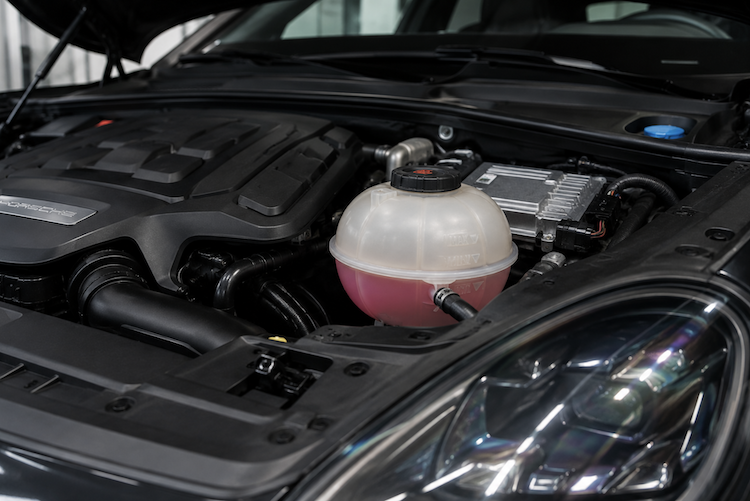
On the Cayenne, coolant is checked via the translucent expansion tank, not a traditional radiator cap. It's located in the engine bay and clearly identifiable as a white or light-colored plastic reservoir. Its exact position varies slightly by generation:
955/957 Cayenne (2003-2010): toward the rear of the engine bay on the passenger side
958 Cayenne (2011-2018): on the passenger side of the engine bay, clearly labeled
9YA Cayenne (2018-present): toward the front passenger side of the engine bay
If you're unsure of the location, your owner's manual includes a diagram of the engine bay layout for your specific generation.
Step 3: Check the Level Against the Markings
Look at the side of the translucent reservoir, you'll see MIN and MAX markings. The coolant level should sit between these two lines. Because the tank is translucent, you can read the level from outside without opening it. Only open the cap if you need to add coolant, and only when the system is completely cold.
Step 4: Add Coolant If Necessary
If the level is below the MIN line, add the correct Porsche-approved coolant using a funnel to avoid spills. Add slowly and recheck the level as you go to avoid overfilling above the MAX line. Replace the cap securely and tighten it after adding.
If the level is above the MAX line, don't drive the vehicle until excess coolant has been carefully removed. An overfilled cooling system can cause pressure issues and damage seals.
Choosing the Right Coolant for Your Porsche Cayenne
This is where many owners make costly mistakes. All Cayenne models require a specific coolant type, not just any antifreeze from an auto parts store.
Porsche recommends a pink or purple OAT (Organic Acid Technology) coolant, specifically Porsche Coolant G13 or a compatible equivalent meeting PCHE approved specifications. This coolant should be used pre-mixed at a 50/50 ratio with distilled water, or purchased as a pre-mixed solution.
Never use green conventional coolant in a Porsche Cayenne. Green coolant uses different inhibitor chemistry that's incompatible with Porsche's aluminium engine components and cooling system materials. Mixing green coolant with Porsche-approved pink or purple coolant also degrades both fluids and can cause deposits inside the cooling system.
If Your Coolant Level Is Consistently Dropping
Adding coolant once because the level was slightly low isn't a cause for alarm, minor evaporation over time is normal. But if you find yourself adding coolant repeatedly, or the level drops noticeably between checks, that points to a leak somewhere in the cooling system.
Common sources of coolant loss on the Cayenne include:
Deteriorating coolant hoses, particularly on higher mileage 955/957 generation vehicles
A failing water pump seal, a known wear item on the Cayenne, particularly on V8 models
Expansion tank cap seal failure, where a worn cap seal allows pressure to escape and coolant to evaporate faster than normal
Head gasket deterioration on higher mileage engines, particularly those that have experienced overheating events
A coolant system that requires regular top-ups needs professional diagnosis. Continuing to add coolant without finding the source of the loss risks a sudden failure at an inconvenient and potentially dangerous moment. Staying ahead of it is a lot easier once you know what a Cayenne's maintenance cost and schedule actually looks like, since cooling system checks are usually folded into the same visits as everything else.
What Our Peoria Technicians See
At Arrowhead Imports, coolant-related issues on Cayennes follow a consistent pattern. The vehicles that arrive with the most serious cooling system damage are almost always those where early warning signs, a slightly elevated temperature gauge or the occasional low coolant warning, were monitored rather than investigated.
The most common preventable issue we see on older Cayenne models is water pump failure that was preceded by weeks of minor coolant loss the owner attributed to normal evaporation. A pressure test of the cooling system would have identified the developing seal failure at a fraction of the eventual repair cost.
The second most common issue is incorrect coolant type, green coolant added by a previous owner or a non-specialist shop that caused internal deposits and compromised cooling efficiency. If you've purchased a used Cayenne and aren't sure of the coolant history, a coolant flush and refill with the correct specification fluid is worthwhile early in your ownership. And if you're weighing repair costs more broadly, Cayenne repairs tend to run less than most people assume compared to other luxury SUVs, largely because it shares parts with other models in the Porsche lineup.
Getting It Checked
If you have any questions about your Cayenne's cooling system or want a professional inspection, contact a qualified Porsche mechanic at Arrowhead Imports.
You can also request an estimate here if you'd like a sense of cost before booking anything.
Prefer to reach out a different way? Get in touch online and we'll follow up with next steps.
Frequently Asked Questions
Where Is The Coolant Reservoir On A Porsche Cayenne?
The coolant expansion tank on the Porsche Cayenne is a translucent plastic reservoir in the engine bay. Its exact location varies by generation, on the 955/957 it sits toward the rear passenger side of the engine bay, on the 958 and 9YA it's positioned on the front passenger side. The owner's manual includes a diagram of the engine bay layout for your specific model year.
What Coolant Does A Porsche Cayenne Use?
Porsche Cayenne models require a pink or purple OAT coolant meeting Porsche's PCHE specification, specifically Porsche Coolant G13 or an approved equivalent. It should be used pre-mixed at a 50/50 ratio with distilled water. Never use green conventional antifreeze in a Porsche Cayenne, since it's chemically incompatible with Porsche's cooling system components.
How Often Should Coolant Be Checked On A Porsche Cayenne?
Check the coolant level visually every month and before any long journey, particularly in hot climates like Peoria, AZ, where the cooling system works harder than in cooler regions. A full coolant flush and replacement is typically recommended every four to six years or as specified in your owner's manual for your generation.
Can I Add Water To My Porsche Cayenne Coolant If It Is Low?
In an emergency, distilled water can be added temporarily to bring the level up, but tap water should never be used, since the minerals it contains cause deposits and corrosion inside the cooling system. After adding water, the coolant concentration will be diluted and should be corrected with the proper Porsche-approved pre-mixed coolant at the next available opportunity.
Why Does My Porsche Cayenne Keep Losing Coolant?
Occasional minor loss through evaporation over a long period is normal. Repeated or noticeable coolant loss indicates a leak, common sources on the Cayenne include deteriorating hoses, a failing water pump seal, a worn expansion tank cap, or in more serious cases head gasket deterioration. Continued driving with a cooling system leak risks overheating damage that's significantly more expensive than diagnosing and repairing the leak early.
Is It Safe To Drive A Porsche Cayenne With Low Coolant?
Not recommended. Low coolant reduces the cooling system's ability to manage engine temperature, which risks overheating, particularly in hot weather or under load. If the coolant warning light is on or the temperature gauge is elevated, stop driving and allow the engine to cool before checking the level. Continuing to drive an overheating engine can cause head gasket failure and significant internal engine damage.